
Detailed Description
This dataset provides pre-processed spatial features extracted from uplink Sounding Reference Signals (SRS) in a indoor environment. Utilizing a O-RAN 7.2 fronthaul setup with a 4 external antenna array, the data is designed to be immediately ML-ready, avoiding the heavy I/O overhead of raw I/Q signals.
Key Extracted Factors
Instead of raw I/Q samples, the dataset provides essential pre-processed spatial and signal parameters:
- Time-domain CIR Taps: Normalized Power Delay Profile (PDP) capturing multipath reflections.
- Phase Differences: Relative phase shifts between antennas, encoded to capture spatial variance.
- Signal Power (dB): Total received power across all antennas.
- Spatial Power Differentials: Received power differences (dx, dy) across the antenna array to determine general spatial quadrants.
- Frequency-domain Amplitudes: Subcarrier amplitudes optimized for tracking sudden physical disturbances.
Supported Use Cases
The dataset is structured to support three primary machine learning-driven use cases:
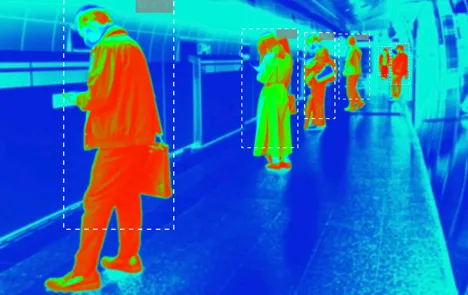
- Real-Time Human Blockage Detection: Utilizing frequency-domain signatures and sudden received power (dB) drops to instantly detect physical disturbances, such as human movement or Line-of-Sight (LoS) blockages in the sensing area.
- Single-UE Indoor Positioning: Mapping the extracted multi-antenna CIR footprints to physical 2D ground-truth coordinates. This enables the training of models (e.g., Random Forest) to accurately estimate a single device's position and Angle of Arrival (AoA) in a multipath-heavy indoor environment.
- Multi-UE Spatial Tracking: Handling simultaneous signal reflections and transmissions from multiple devices. This challenges spatial tracking algorithms to process overlapping signatures, resolve spatial ambiguities, and track multiplexed targets concurrently.